Global Challenges; Redefining Approaches and Shared Solutions

The twenty-first-century global challenges are testing the boundaries of our collective imagination. Across every sector of human endeavour, we find ourselves confronted by challenges that defy the tools of the past. Healthcare systems strain under new diseases and ageing populations. Immigration remains deeply contested as people move across borders in search of safety or opportunity.
Additionally, climate change reorders entire landscapes and forces reconsideration of what it means to live responsibly on a planet with finite resources. Finance and investment have become more volatile and more interdependent than ever. Education faces a reckoning as knowledge is both democratised and destabilised in a digital world.
What ties these domains together is the insufficiency of traditional approaches that are hierarchical, slow, and rigid. The moment requires something else: adaptability, agility, lean practices, and above all, a systems-oriented way of thinking.
Global Challenges and The End of Linear Thinking
For centuries, problem-solving has often been approached as if challenges were puzzles to be solved with a single correct answer. Healthcare was about treating disease once it appeared, immigration was about border management, finance was about accounting, and education was about the transmission of facts. Each field operated within narrow boundaries with little recognition that the problems they faced were connected.
Today, this form of linear thinking collapses under the weight of complexity. A virus in one corner of the world rapidly becomes a global threat. The movement of refugees is bound to geopolitical conflict, climate disasters, and economic systems. Investment strategies cannot ignore environmental risk without creating fragile portfolios. Education cannot limit itself to memorisation when the half-life of knowledge is shrinking.
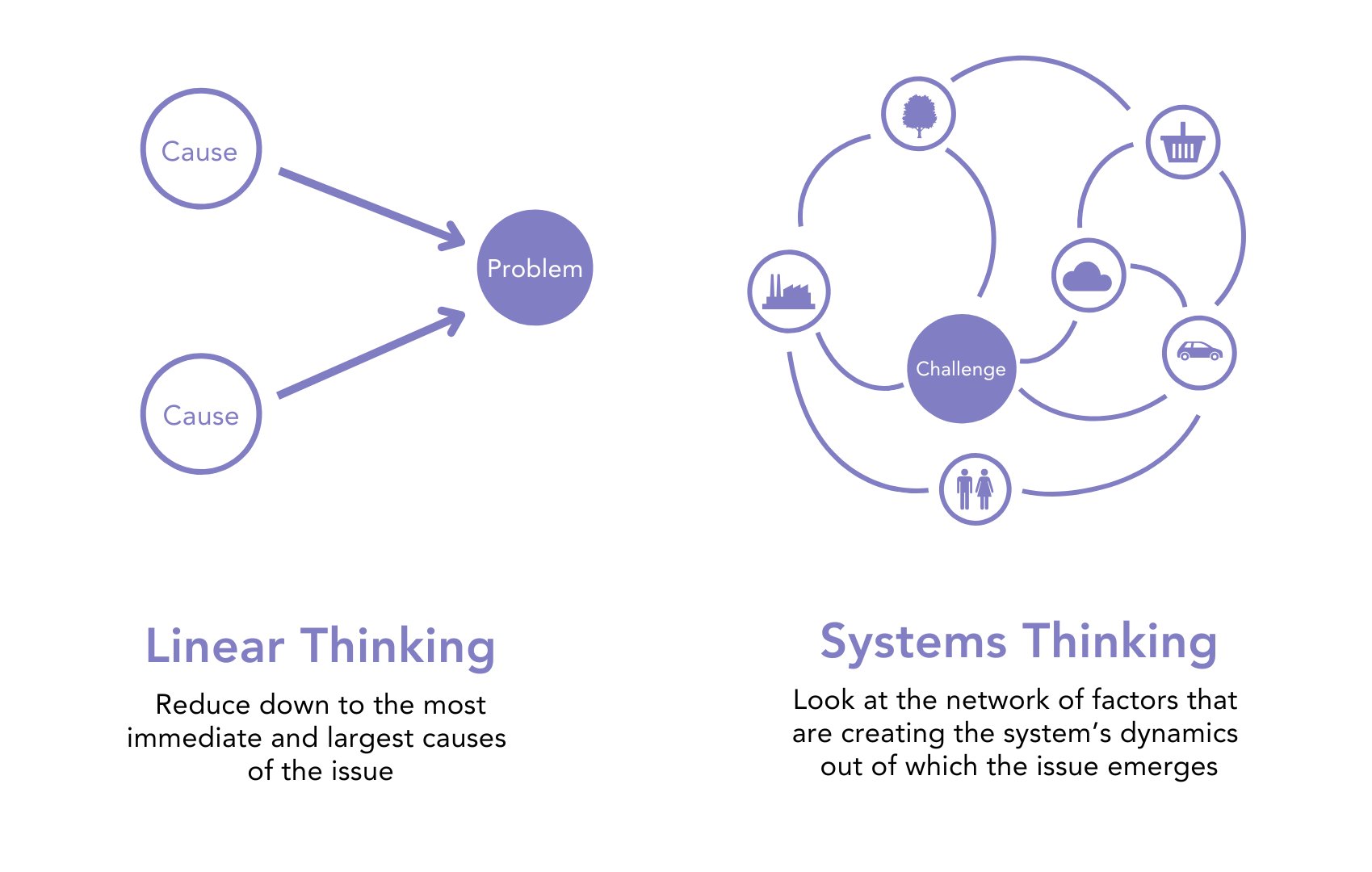
Linear thinking belongs to a slower world. The accelerating pace of change demands that we see challenges as dynamic ecosystems rather than isolated incidents. This shift is not merely technical but cultural, requiring leaders and citizens alike to embrace a mindset of adaptation.
Healthcare: From Treatment to Anticipation
Consider healthcare. Traditional models have focused on intervention after the occurrence. When a patient becomes ill, the system responds, and outcomes depend on the efficiency of treatment. Yet this approach fails in the face of pandemics, chronic disease, and the enormous cost burdens associated with late intervention. An adaptable system must look forward rather than backward.
Imagine a city that integrates health data across hospitals, schools, transportation, and environmental monitoring. Using lean approaches, unnecessary layers of bureaucracy are eliminated, and data flows in real-time.
Citizens are not passive recipients of care but active participants. Early warning systems detect trends such as rising asthma incidents linked to air pollution. Instead of waiting for hospital admissions to surge, the city mobilises targeted interventions at the source. This is healthcare not as a “repair shop” but as a living organism, actively anticipatory and adaptive.
Immigration: Beyond Borders Toward Systems of Belonging
Human migration is often framed as a crisis of numbers. We are looking at how many people cross a line, how many are allowed in, and how many must be turned away. Traditional approaches tend to swing between generosity and restriction, rarely examining the system that creates movement in the first place. Climate disasters displace communities, financial inequities push workers to seek better opportunities, and conflicts leave people with no home.
Addressing immigration only at the border is akin to treating symptoms while ignoring the root causes.

An agile approach would link migration policy with development, climate adaptation, and education, both at home and abroad. Imagine a regional partnership where nations invest collectively in climate resilience projects, reducing forced displacement while also creating new shared industries.
Immigrants who do arrive are not viewed as burdens but as contributors to adaptive economies, supported by lean integration programs that reduce administrative waste and accelerate paths to participation. Such systems thinking reframes immigration not as a zero-sum contest but as a shared responsibility shaped by global interdependence.
Climate Issues: From Crisis Response to Adaptive Stewardship
Climate change exposes the futility of fragmented strategies. Traditional models often oscillate between denial, incremental mitigation, and emergency response after disasters. These approaches leave societies perpetually unprepared.
A systems mindset requires us to view the planet as an integrated web where energy, water, agriculture, and culture are inseparable. Here is a hypothetical example. Think of a coastal nation facing rising seas that decides not to build higher walls alone but to rethink urban life. New housing is developed inland in modular and flexible designs. Such an approach avoids reactive interventions.
Educational curricula prepare future generations to live with changing ecosystems rather than resist them. Finance is directed toward regenerative industries that create value without exhausting natural capital. The entire society becomes a laboratory of adaptation, not merely survival. This is the kind of thinking required to move from reactive crisis management to resilient stewardship.
Finance and Investment: From Profit to Resilience
Financial systems have traditionally valued immediate returns and growth, often measured narrowly in quarterly cycles or semi-annually. The result is volatility, fragility, and misallocation of capital. The 2008 financial crisis revealed the dangers of a system blind to interconnected risks. Today, climate exposure, technological disruption, and social unrest (or wars) pose similar systemic threats.
Agile finance does not mean reckless risk-taking but rather a shift toward resilience. Investors must ask how portfolios can remain viable in the face of planetary and societal transformations. Lean investment strategies reduce unnecessary complexity by channelling resources into ventures that combine profitability with social and environmental sustainability.

A systems approach recognises that unchecked profit in one sector can generate collapse in another. For example, investments in fossil fuels may yield short-term gains but undermine long-term economic stability. In contrast, supporting renewable energy, circular economies, and inclusive enterprises cultivates a future where finance serves as a stabilising force rather than a destabilising one.
Education: Preparing for Uncertainty
Education may be the most decisive arena of all. Traditional models prepared students for stable careers in predictable environments. Knowledge was fixed, expertise was transmitted, and progress was measured by exams. Yet the future is characterised by uncertainty, automation, and rapid reinvention of industries. What children learn today may be obsolete tomorrow. Or by evening, in demonstration of this reality.
Systems thinking in education means cultivating not just information but adaptability. Schools must train learners to ask questions, to navigate ambiguity, and to collaborate across disciplines. Imagine an educational system that mirrors the adaptability of a start-up. It ensures projects are iterative, students engage in real-world problem-solving, and curricula evolve continuously in response to societal needs. Such a system recognises that the most valuable skill is not knowing a specific fact, but learning how to learn.
Strategic Insights for the Future
The future demands a shift in how we conceptualise leadership and citizenship. Several strategic insights emerge across these domains.
First, adaptability is no longer optional. Institutions must be able to pivot rapidly in the face of new data, technologies, and disruptions. Rigidity is a liability. Simple.
Second, agility must be embedded at every level of decision-making. Short feedback loops, transparent communication, and willingness to experiment are critical. In fact, they are a necessity.
Third, lean practices reduce waste and allow resources to be channelled directly to where they are most effective. Bureaucracy and delay are forms of waste we can no longer afford. Unfortunately, bureaucracy continues to stifle innovations in modern organisations. Complacency is most obvious with bureaucracies.
Finally, systems thinking is the connective tissue. It allows us to see how healthcare interacts with climate, how immigration is tied to finance, and how education underpins resilience across all sectors. It reframes problems not as isolated challenges but as opportunities for integrated solutions.
Finally
The world we inhabit will never again be simple, linear, or slow. That time is long gone. Attempts to solve twenty-first-century challenges with twentieth-century tools will fail. But this should not cause us to despair. It is a wake-up call to redefine what it means to be creative, collaborative, and adaptive.
Suppose we cultivate the capacity to think in systems, to act with agility, to remain lean in our practices, and to embrace adaptation as a way of life. In that case, the challenges before us become not insurmountable threats, but opportunities to reshape our shared future.
This is the work of our generation. The choice is whether we cling to the familiar comfort of outdated approaches or step forward into the uncertain but promising terrain of adaptive systems thinking. The future will reward those who choose the latter. The ones who dare.