AI, Power and the End of Intellectual Independence?
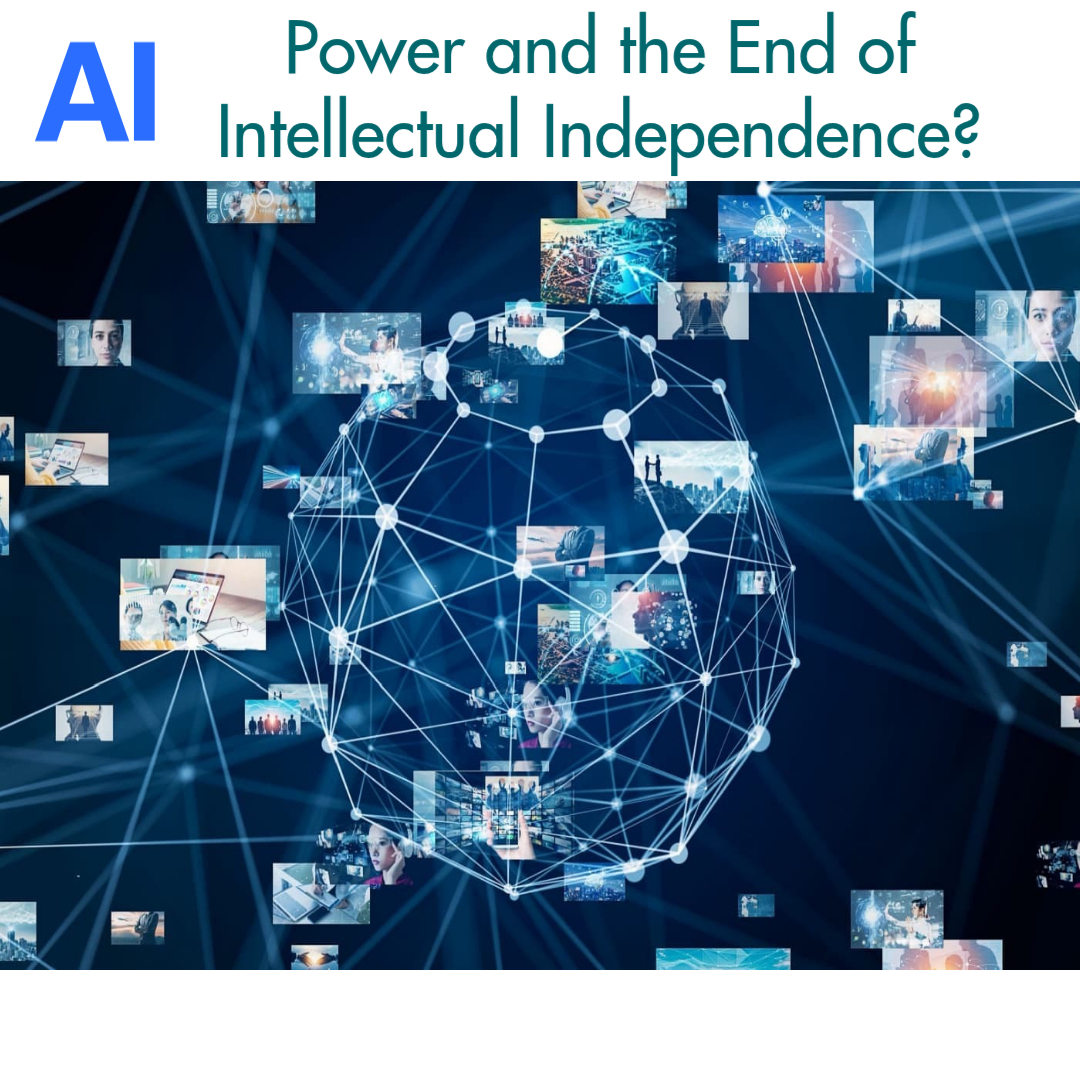
AI is shaping our fundamental understanding of knowledge, but it also risks altering human cognitive and critical thinking.
For most of human history, knowledge was scarce. But that changed, and today, knowledge is abundant. However, there is a new scarcity called discernment. Understanding the distinction between abundance and logical facts and truth is critical in the debate surrounding artificial intelligence.
You wonder why I said so? Because some aspects around AI are often framed incorrectly. For instance, we are told that AI is about productivity, automation, efficiency, innovation, or economic growth. Good. Whereas these concepts are certainly part of the story, they are not the story.
The deeper question that begs answers is whether AI represents the greatest democratisation of intelligence in human history or the greatest concentration of cognitive power ever created. And not so surprisingly, the answer may be both.
The Shift from Tools to Agents
The first wave of artificial intelligence was largely assistive. We used search engines to help us find information. Recommendation systems helped us discover content and expanded our access to available information and knowledge.
Also, machine learning models helped identify patterns within vast datasets. Even the earliest large language models functioned primarily as advanced tools responding to human prompts.
Here comes the era of Agentic AI, and the equation changes entirely. Agentic AI does not just answer questions; it can formulate objectives, evaluate alternatives, make decisions, execute actions, and learn from outcomes. Increasingly, these systems can perform tasks once reserved for human judgment.
This transition from Generative AI to Agentic AI marks a philosophical threshold. This is the core of the tensions and threats of this revolution. Take, for example, a calculator. It just responds to instructions and never threatens human autonomy (because it has no autonomy itself). What of an agent, an artificial one for that matter, capable of making consequential decisions?

This introduces a fundamentally different relationship between humans and machines. And with it, some unique dangers. If you’re still asking if machines can think, you’re left behind. Today’s discourse is centred on the question of what point humans will stop thinking because machines think for them.
With superintelligent AI and the ever-increasing focus on advancing neuromorphic computing, we are at the tipping point of a new human development. Should we even worry about human intellectualism when machines can do almost all we have always done? Why should we think when a machine can? Does this pose an opportunity or a danger or both?
The Case for Trusting AI
It’s a fact that human decision-making has flaws because we are emotional beings. This is the basic difference between us and AI. We have biases, tribal and racial inclinations, we get distracted and corruptible and depict irrationality in thinking.
Because of this, our political interpretations are often skewed by cognitive biases, corruption distorts truth, and our political views and ideologies affect our interpretation of pertinent issues. The end product is increased inequity and inequality, which ultimately leads to societal conflicts.
Thus, the arguments of some advocates of AI deserve consideration, since what they present is not irrationally blinded by pure optimism. Many of society’s failures are not failures of intelligence but failures of human judgment. This is what makes AI appear attractive.
An AI system does not become tired during surgery. It does not accept bribes. It does not suffer from ego, tribal loyalty, or emotional exhaustion. AI can identify patterns invisible to human clinicians in medicine. It can optimise supply chains in logistics beyond human limitations, and much more.
The proponents of AI do not present it as the perfect solution; rather, they argue that humans are often worse. They present it as an assistive tool capable of reducing human error and increasing societal efficiency.
From this perspective, the argument is compelling. Refusing to accept AI within those confines then could become as irrational as refusing to trust modern medicine or aviation systems. Unfortunately, it doesn’t stop there.
The Case Against Trusting AI
This past week I read and listened to more presentations about AI than anything else. It is a real current issue. What I picked up throughout the engagements was the criticism that AI may become authoritative. Somehow there is a feeling that it has already become, with all its limitations.
So far, there are fewer concerns about AI becoming conscious. In fact, people do not need to believe an AI is conscious to obey it. They only need to believe it is correct, even on moral issues where the code may be ‘interested’ in what one would love to hear. For me, this is where the danger begins. Machine legitimacy.
An AI model is not an objective observer of reality. It is a statistical reflection of the data upon which it was trained and the objectives encoded into its architecture. The datasets used to train the models contain assumptions, the selection process contains biases, the filtering mechanism contains values (whose values??), and the optimisation target contains political and philosophical choices (whose??).
With scrutiny and questioning, the myth of AI neutrality collapses. No model exists outside a framework of incentives, constraints, and assumptions. More critically, who decides what the model learns? Who decides what information is excluded? Who decides which narratives are elevated? Who decides which values become embedded? I am hinting at control with all this questioning.

Eventually, the controller of the training data is, in many respects, the controller of the perception itself. That is how he/they influence not only what people know but how they think.
Historically, power belonged to those who controlled territory. Think of Alexander the Great and his conquests. Then it belonged to those who controlled capital. Think of London as the ‘capital centre’ of the world in the 19th and early 20th centuries.
Today, it increasingly belongs to those who control information. Tomorrow, it is likely to shift to those who control cognition. Now you understand?
The New Information Aristocracy
A lot of people often dismiss the concept of cognition control as paranoia. It should not be. Again, throughout history, religious institutions, governments, universities, media organisations, corporations, and institutions, large and small, have attempted to shape narratives. The largest difference today is the scale.
Previous key players influenced how information flowed (flows today). AI is essentially poised to influence reasoning itself.
If billions of people increasingly rely upon AI systems to summarise reality, answer questions, recommend actions, interpret events, and mediate understanding, then the designers of those systems occupy an unprecedented position.
For the first time in history, a small number of organisations may possess the ability to shape collective cognition at planetary scale. That should scare us, and it is not a secret. Well, it may not necessarily be a conspiracy, though it can be. However, we cannot ignore the centralisation of power, information, data, capital and its influence on this development.
The tinge of hope that remains is imbued in lessons from the past, which, time and again, have always demonstrated that concentrated power rarely remains indefinitely. As for the effect on humanity, only time will tell.
Independent Thinking in the Age of AI
This may be the most underappreciated and underacknowledged issue in the entire debate. Many of us often assume that intelligence and thinking are identical. They are not.
Whereas intelligence is the capacity to generate answers, thinking is more about the process of struggling toward understanding. A student who receives every answer instantly by prompting a chatbot may become more informed while simultaneously becoming less capable of reasoning.
Convenience and intellectual development rarely move in the same directions. Haha! The danger of AI is therefore not that it replaces intelligence but that it replaces intellectual effort. Intellectual laziness hampers human development, and may eventually lead to human extinction. My thoughts, though.
We develop judgment through uncertainty, disagreement, failure, ambiguity, and reflection. Ever noticed anything with AI regarding all these? Over time, excessive reliance on machine-generated conclusions may produce populations that know more facts but possess less wisdom.
The Philosophical Problem: What Is Truth?
The AI debate ultimately collides with a much older philosophical question, especially around moral relativism. For example, consider the concept of truth. Modern societies mostly take truth as objective and discoverable.
Postmodern thinkers challenge this assumption. They argue that truth is shaped by language, culture, power structures, and/or historical contexts. This was the origin of relativism, which leans towards truth as contingent upon frameworks of interpretation rather than existing as an entirely independent entity.
AI enters this philosophical battlefield carrying enormous implications with alignment. Large language models possess probability and not truth. They generate responses based on patterns even when the most statistically likely answer is not necessarily the most accurate one.
Based on probability, the most popular narrative may carry the day, but it may not necessarily be the truest one. This creates a subtle but profound problem. Because AI systems are becoming dominant mediators of information, societies are likely to shift from considering truth to what the models say. And this will happen subconsciously.
On a Deeper Sense, Have Humans Ever Been Independent?
There is a part of the defenders of AI that offer a powerful rebuttal to the AI manipulation assumption. They point to history, which suggests that the concept of humans as free thinkers is flawed. People have always been shaped by culture, education, religion, media, family structures, and political institutions. The latter has had its own “AI” called propaganda since time immemorial.
It is believed that the idea of the completely independent thinker may itself be a myth. Human cognition has always been socially constructed. AI then plays a revelatory role in uncovering these existing influence mechanisms rather than playing an active role in the influence.
Furthermore, AI is democratising expertise by making knowledge accessible to individuals who previously lacked access. The same technology that could centralise power may also decentralise opportunity.
Today, a child in a remote village can gain access to capabilities previously available only to elite institutions. This possibility should not be underestimated and may make AI become the greatest equaliser humanity has ever created.
On the other hand, it may be the greatest amplifier of existing inequalities. Most likely, it will become both, simultaneously.
AI: Beyond Utopia and Dystopia
The public discourse surrounding AI is dominated by extremes, with one side predicting salvation and the other predicting catastrophe. The reality will probably be less dramatic and more complicated. AI is neither inherently liberating nor inherently oppressive.
Like every transformative technology before it, its consequences will depend on governance, transparency, distribution of power, and human wisdom. The real challenge has moved beyond building smarter machines. We are doing an excellent job on this.
The real challenge now is ensuring that increasingly intelligent systems do not coincide with increasingly passive humans. Technology has always extended human capability. The defining question of the AI age is whether it will also diminish human agency.
This question will remain unanswered for now, and time will reveal the answer. In my mind, it’s perhaps the question that truly matters for this moment.
We don’t have a war against machines. The war is inside us. It is about the kind of humans we become in response to machines’ agency. It is about knowing clearly the objectives and narratives driving this discourse and what that means for the future of humanity.