Kenya’s First-World Dream Built on Hope Ahead of the Work (Part 1)

Kenya’s first-world dream and Vision 2060 are becoming a daily topic among the political class in the wake of the 2027 election period. Interestingly, our country has never suffered from a shortage of ambition, to say the least.
For decades, we have been told that our country is destined for greatness. We have heard of Vision 2030 thousands of times, and walked through it with 3 years short of the 2030 mark. It built on the hopes of middle-income status, industrialisation, universal healthcare, world-class infrastructure, and a technology economy. And more recently, an increasing aspiration to become a first-world country.
There is nothing wrong with dreaming big. In fact, we all dream big or rather, are encouraged to dream big. There is no harm in doing it at the national level as well. But there is a big problem. I used the word problem intentionally.
It is the fact that our leaders, and by extension the citizens, have increasingly confused the language of transformation with the actual work of transforming a country.
A nation does not become developed or prosperous because its leaders announce ambitious visions and launch programmes with impressive names. First-world countries never became developed because their presidents promised to change the economy, build infrastructure and create jobs.
Those countries became developed because their institutions work(ed). And they made it happen more than they sang about it.
If you have had an opportunity to go to some of these fairly functional countries, you’ll realise that schools teach a well-structured, relevant curriculum, hospitals treat all people accessibly, and courts deliver justice.
Their parliaments scrutinise government. Procurement systems protect public money. Police protect citizens. Regulators regulate. Businesses are empowered to compete on a global scale. Infrastructure gets planned according to national priorities rather than political convenience. Public servants are professionally recruited and held accountable. And corruption carries consequences regardless of who is politically connected.
I wish I could stop at that and ask our leaders to work and attain this level of description, and we wouldn’t need to explain to anybody about first-world status. It would be visible. It would be a reality lived and experienced.
This was the dream of Kenya’s 2010 constitution. By now, almost 2 decades after promulgation, our situation should be far better than it is at present. But now, this is where things become uncomfortable.
The Constitution promised a different Kenya
The 2010 Constitution was not merely a new administrative arrangement. It was an ambitious social contract. It has been often described as the most progressive constitution since our independence and among our peers in Africa.
For instance, Article 10 binds state organs, state officers and public officers to values including the rule of law, democracy and public participation. Public institutions and leaders are to uphold human dignity, equity, social justice, good governance, integrity, transparency, accountability and sustainable development. There is a lot left to be desired if we measure Uhuru and Ruto’s governments on these metrics.
I picked these two governments because they have served/serving after the adoption of the 2010 Constitution.
Article 21 further imposes a duty on the State to observe, respect, protect, promote, and fulfil fundamental rights. Then comes Article 43, which gives every Kenyan the right to the highest attainable standard of health, accessible and adequate housing and sanitation, freedom from hunger, clean and safe water, social security and education.
The fact is that these are not campaign slogans but constitutional commitments.
The Constitution also conceived devolution as much more than the creation of 47 county governments. Article 174 says that devolution is intended to promote the accountable exercise of power, and give people greater participation in decisions affecting them. It is to promote social and economic development, bring accessible services closer to citizens, ensure the equitable sharing of resources, and strengthen checks and balances and the separation of powers.
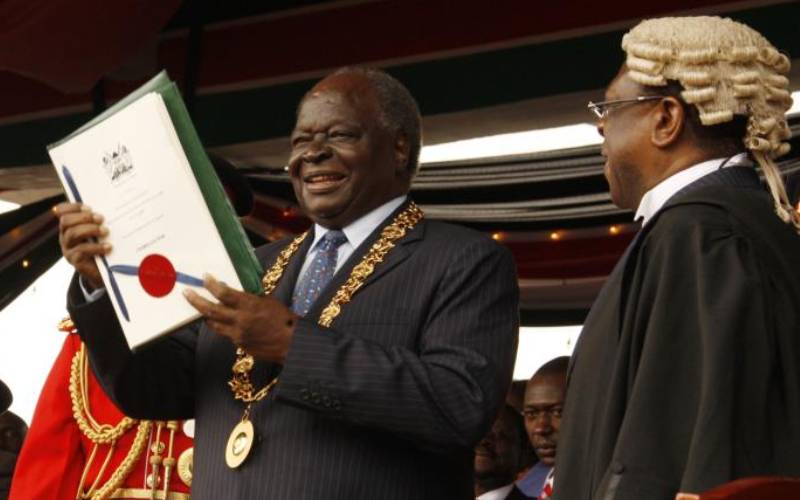
Sixteen years after promulgation, we are still grappling with an unclear national blueprint. Not because we don’t know what country we want, because the constitution has laid it bare, but because we have been so reluctant to do the institutional work required to build it. And this anchors my topic today.
Uhuru and Ruto: different politics, familiar weaknesses
The Uhuru Kenyatta and William Ruto administrations should not be treated as identical even though they are sort of clones of each other. They emerged from different political circumstances, adopted different rhetoric and pursued different policy priorities.
But viewed from the perspective of prioritising the ordinary citizen and the Kenya we envisioned and envision, neither administration has sufficiently converted the constitutional promise of 2010 into a durable culture of functional institutions.
The Uhuru years brought us major infrastructure projects, devolution took root, and Kenya’s physical landscape changed considerably. Roads, railways, energy projects and other large developments demonstrated that the Kenyan state could mobilise substantial resources for ambitious projects.
But the period also exposed the weaknesses of a political system in which large public expenditure could coexist with persistent questions over procurement, debt, accountability and corruption. During that period, we normalised disrespect for the constitution’s dictates.
The lesson should have been obvious. That infrastructure without institutional discipline can become an expensive monument to poor governance. Unfortunately, the current president missed the memo on these lessons, given he was serving in that government.
Then he, Ruto, came to power promising a different economic philosophy anchored on a bottom-up approach intended to improve the position of ordinary citizens. It was an elegant economic philosophy that has become just that: a philosophy.
The fundamental test is simple: have citizens experienced a better state? As a Kenyan, answer the following questions, and you will rate the state in which we are as a country, at the moment.
Today, can a mother obtain affordable medical care any time? Can a young person leave school with skills that employers actually need and also find meaningful employment? Can a small manufacturer produce competitively? Can a farmer’s produce reach a market at reasonable cost? Can a business obtain a government service without paying a bribe? Can a citizen challenge government without fearing retaliation? Can Parliament effectively restrain the Executive?
We can go on and on, but these questions capture some critical components of those measurements that matter. And the moment of truth? Kenya remains far from the country our political class routinely describes.
Corruption is not simply stealing money
Our corruption problem is often discussed as though it is merely about money disappearing from government accounts. Yet it is much bigger than that. Corruption can best be described as destruction of national capacity.
When procurement is manipulated, a country loses more than money; it loses value creation. It gets roads that cost too much or hospitals that are poorly equipped. It could mean schools lack facilities, water projects do not function, or information systems cannot deliver the services they are supposed to provide. This looks like Kenya.
The Office of the Auditor-General exists precisely because constitutional government requires mechanisms to determine whether public money has been used lawfully and effectively. Its mandate covers the Executive, Legislature, Judiciary, national and county governments and other publicly funded entities.
Unfortunately, audit reports have become part of Kenya’s annual political theatre. Findings are published, politicians express outrage and dissatisfaction, committees deliberate, explanations are offered, and the country moves on. That is not accountability. Accountability means consequences.
The persistence of this problem is reflected in our ranking in Transparency International’s Corruption Perceptions Index. In the 2025 index, Kenya scored 30 out of 100 and ranked 130th among 182 countries, down from 32 in 2024.
These figures demonstrate that our country has not built sufficient confidence in the integrity of its public sector. And that failure belongs to more than one administration, given systems are supposed to be self-sustaining over time.
The Ruto administration’s indictment
The current government deserves particular scrutiny because it came to office promising to be different. Instead, corruption controversies and questions surrounding public procurement have continued to dog it.
The proposed Adani transactions became a particularly powerful illustration of the problem. The proposed airport arrangement faced intense public and legal scrutiny over procurement and transparency before the president eventually cancelled the process in November 2024. The same scrutiny has been sustained and keeps pointing to a systemic and endemic problem.
The important point here is that our government should design procurement systems so transparently that we, the citizens, do not have to discover major national transactions through leaks, controversy or court challenges. A first-world state does not depend on presidential intervention to rescue procurement credibility after public outrage.
It builds systems that prevent the credibility crisis from occurring in the first place. That is the difference between governance and political management.
Parliament too often behaves like an extension of the Executive
The Constitution deliberately separated state powers because the architects of the new Kenya understood that concentrated political power eventually becomes dangerous. We know that from history.
Parliament is supposed to legislate, represent the people and scrutinise the Executive. But Kenya’s parliamentary politics has reduced this constitutional responsibility to just numbers. In fact, parliament seems to be losing credibility with each passing day.
What plays out in the open, and in politics, is that the Kenya Kwanza governing coalition controls the parliamentary majority. Today, oversight is conditional upon political loyalty. Members who should be asking difficult questions instead have become defenders of the government whose conduct they are constitutionally required to scrutinise.
Our parliament has been weakened to tell the truth. It has lost its institutional independence, which is what matters most.
But there is some little hope. The 2024 Finance Bill crisis (Gen Z revolution) demonstrated the power of public pressure as a tool of change and also the weakness of political accountability. The proposed tax measures triggered unprecedented youth-led demonstrations that forced President Ruto to withdraw the legislation.
Fundamentally, the protests exposed a deep public dissatisfaction with government priorities and the political establishment. Again, unfortunately, the lessons were not taken.
A healthy democracy should not require citizens to take to the streets before elected representatives listen. Parliament should be the first line of democratic accountability, not the last line before public anger explodes.
The message is clear. Parliament should do its work. The president should allow the various institutional arms to work independently, indeed, not in word. Our country should build systems independent of political cycles. Only then can we have sustained development that will take us to first-world status. We don’t even need to convince people about it; it will be visible.
More importantly, the president should fight corruption. He rarely speaks about it, and that can be misinterpreted otherwise. He must actively initiate and support the efforts to fight corruption.
In part two of this series next week, we will continue this discussion and will share some actionable ways we can become a real first-world country beyond empty hope and promises.