There is Danger in Being a Good Person.
A good person is a good person. Simple. In other words, a dozen other people will tell you positive things about people deemed good, and it is never by coincidence. It doesn’t necessarily mean they are perfect; however, they are largely identified by key attributes. They are kind, selfless, forgiving, loving, humble, and deeply caring.
Something more: they radiate a seamless connection. Other people are easy around them, and they bring happiness to the world. Not the comedy type, sometimes just unspoken.
The only danger with being a good person is the confusion that arises from being assumed to be perfect.
From my many interactions, I can say, authoritatively, that some of the good people I have met have had the worst broken pasts. They have had to go through the furnace for them to be refined. But most intriguing of all is the fact that their broken pasts don’t change their goodness. They remain good and continue hawking their goodness.
But here is the paradox. In our world today, which is driven by selfishness and personal ill pursuits, being a good person can be a red flag. Funny, yeah?
I have seen many times people raise concerns about the “too much goodness” of a person. If I can escalate, goodness becomes a kind weakness. Here is the hard fact, though: to the average or low-value person, goodness is mistaken for a weakness. Yet to the high value one, they know that goodness is a strength. Unfortunately, high-value people are a scarce commodity.
And scarcity creates distortion.
When goodness is rare, suspicion becomes common. People start asking uncomfortable questions. “Why is he so nice?” “What does she want?” “Nobody is that good.” It is as if we have been conditioned to believe that every smile hides a scheme. That every helping hand has invisible strings attached.
It is understandable to a certain extent. And history has given us reasons to be cautious. There have been individuals who mastered the art of appearing good while being dangerously deceptive. Consider Victor Lustig, the infamous con artist who “sold” the Eiffel Tower not once, but twice.
Lustig thrived not because he looked like a villain, but because he looked respectable. He spoke gently. He dressed well. He carried himself as a man of integrity. His victims were prepared for aggression; they fell for his apparent goodness.
Such cases harden society. They make us question sincerity. They train us to look for hidden motives even where there are none. The result? Truly good people are forced to live under suspicion created by pretenders.
But while deception exists, so does genuine goodness.
Think of Harriet Tubman. She risked her life repeatedly to guide enslaved people to freedom. She freed over 300 slaves through the Underground Railroad. She could have secured her own safety and remained silent, but her goodness would not allow it. She had to go back. Again, and again.
It was not weakness that pushed her into danger; it was strength. Her kindness was not softness; rather, courage in motion.
Or consider George Washington. Beyond his military leadership, he is known for voluntarily stepping down from power at a time when he could easily have clung to it. He had every reason to. A father of the nation, to say the least. Yet he exercised restraint.

Restraint is goodness in its purest form. It takes discipline and moral clarity to walk away from what others would kill to possess.
These figures remind us that goodness is not naivety. It is not ignorance. It is not a lack of intelligence. In fact, it often requires deep self-control and sacrifice.
A good Person Often Pays the Price
Yet in everyday life, the good person pays a price. You know that, as I do.
They are expected to forgive endlessly. To give endlessly. To understand endlessly. When they finally say “no,” people are shocked. “But you are not like that,” they are told. But who said goodness was a contract that strips them of their right to boundaries?
This is where the real danger lies.
When a good person is boxed into perfection, they begin to suffocate. They feel pressured to maintain an image rather than live authentically. Their anger must be suppressed. Their disappointment must be swallowed. Their fatigue must be hidden. Over time, this creates internal conflict.
Ironically, the same society that celebrates goodness also exploits it.
Workplaces overload the dependable employee. Families lean excessively on the responsible sibling. Friends take advantage of the always-available one. The good person becomes the emotional shock absorber of everyone else’s chaos.
And because they rarely complain, their burden goes unnoticed. But let us be clear: goodness without boundaries is not virtue; it is vulnerability. Oftentimes, a dangerous vulnerability.
To be good does not mean to be gullible. It does not mean tolerating abuse. It does not mean being blind to manipulation. True goodness must be paired with wisdom. Prudently to say, a kind heart must be guided by a discerning mind.
The problem arises when we confuse passivity with goodness. A good person can be firm. They can be assertive. They can walk away. They can confront wrongdoing. In fact, sometimes the most loving thing a good person can do is to say, “Enough.”
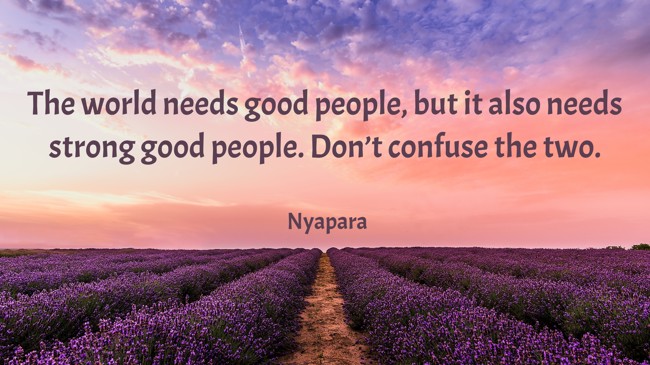
The world needs good people, but it also needs strong good people. Don’t confuse the two.
If you are good, understand this: not everyone will celebrate you. Some will test you. Some will try to exploit you. Some will doubt you. And some will resent you because your integrity exposes their shortcuts.
Your goodness will highlight what others are unwilling to fix in themselves. But do not let that harden you.
The temptation, after being hurt repeatedly, is to become cynical. To reduce your kindness. To join the crowd of the suspicious and self-protective. Yet when good people abandon their goodness, society loses one of its most stabilising forces.
There is already enough cruelty. Enough dishonesty. Enough selfish ambition. What is scarce is sincerity. Goodness is rarely loud. It does not trend. It rarely goes viral. But it sustains communities. It builds trust. It repairs broken spaces quietly.
And perhaps this is why it is often misunderstood. Because goodness does not compete, it does not announce itself. It simply exists. Quietly doing its thing, one good act at a time.
So yes, there is danger in being a good person. The danger of being misunderstood. The danger of being used. The danger of being held to impossible standards. The danger of disappointment.
But there is also a greater danger in not being good at all.
When a society mistrusts every act of kindness, it becomes cold. When a generation equates goodness with weakness, it grows aggressive. And when a culture rewards manipulation over integrity, it slowly corrodes from within.
So, should we stop being good? The answer is no. Instead, let us be good and wise. Kind and discerning. Generous but guarded. Let us help, but not at the expense of our own dignity.
Goodness, when balanced with strength, is unshakeable. And perhaps this is the final truth: that goodness is not fragile. It survives betrayal. It survives suspicion. It survives exploitation. It bends, but it does not break. That is its power.
So, if you are a good person, do not apologise for it. Refine it. Protect it. Strengthen it. In our world that is full of darkness, your goodness may be the quiet light someone desperately needs. Don’t fear to shine it bright.